

It is 399 BCE, and the atmosphere in the Athenian prison cell is heavy with impending grief. Socrates, the founding father of Western logic and reason, sits hours away from drinking the fatal cup of hemlock. Yet, his heart rate is remarkably steady. He is not pacing in terror; he is not bargaining for his life. Instead, he is peacefully analyzing a dream. When exploring the origins of subconscious analysis, a frequent question emerges from historians and modern mindfulness practitioners alike: what was socrates dream, and how did it guide his final waking moments?
The paradox is fascinating. The man who dedicated his life to intense, waking rationality relied heavily on the deeply mystical realm of the subconscious when facing the ultimate unknown. He understood early on that maintaining a calm brain in the face of immense stress requires listening to the stories our minds tell us while we sleep.
Today, we know that dreams are not just random neurological noise; they are highly organized mechanisms for overnight emotional therapy. By exploring the legendary dreams of Socrates, we can uncover an ancient framework for decoding our own subconscious, managing sleep anxiety, and discovering our truest waking purpose.
The Three Legendary Dreams of Socrates
To understand how ancient philosophy intersects with modern dream meaning and sleep science, we must turn to the historical accounts recorded by his most famous student, Plato. In dialogues like the Crito and the Phaedo, we see that Socrates did not just have one profound dream; he had several that shaped his emotional regulation and final decisions.

1. The Dream of the Woman in White: Easing the Ultimate Anxiety
In Plato’s Crito, Socrates’ friend arrives at the prison with a plan for escape. Socrates calmly refuses, stating that his execution will not happen that day, but in three days’ time. His evidence? A vivid dream he experienced the night before.
Socrates describes a vision of a graceful woman dressed in flowing white robes approaching him. She calls to him and recites a slightly altered line from Homer’s Iliad: “On the third day hence, to fertile Phthia shalt thou go.”
The Subconscious Meaning: Historically, Phthia was the home of the great warrior Achilles. However, Socrates did not interpret this as a literal geographic destination. Instead, his subconscious used “Phthia” as a comforting metaphor for his ultimate home—the afterlife.
The Holistic Insight for Today: This dream perfectly illustrates how the subconscious mind attempts to prepare us for major life transitions and severe stress. When we are facing extreme daytime anxiety, our REM sleep often synthesizes comforting, familiar symbolism (like a quote from a favorite book or a culturally significant archetype, such as the woman in white) to soften the psychological blow. It acts as an internal shock absorber. By paying attention to the comforting archetypes in our own sleep cycles, we can better understand how our minds are trying to soothe our waking fears.
2. The Command to “Make Music”: The Brain’s Internal Compass
Perhaps the most famous of his subconscious visions, recorded in the Phaedo, is a recurring dream that followed Socrates throughout his entire life. In this dream, a voice continuously urged him with a simple command: “Socrates, practice and cultivate the arts” (often translated as “make music”).
For decades, Socrates rationalized this dream. He believed that philosophy was the highest and most noble form of “music,” and therefore, his daily practice of debating and teaching was fulfilling the dream’s command. However, in his final days, facing the uncertainty of death, a shadow of doubt crept in. What if the dream meant literal music? To clear his conscience and leave no stone unturned, Socrates spent his final hours composing hymns to Apollo and turning the fables of Aesop into poetry.
The Subconscious Meaning: This is a masterclass in interpreting recurring dreams. The subconscious is persistent. If there is a creative, emotional, or psychological need that you are ignoring or rationalizing away during the day, your brain will repeatedly prompt you during your REM cycle until the issue is addressed.
The Holistic Insight for Today: Many modern sleepers suffer from sleep-onset insomnia or restless tossing and turning because they are ignoring their own “make music” command. Unexpressed creative energy or unresolved daytime conflicts manifest as physical restlessness at night. When we finally address these lingering mental tasks—whether through journaling, taking up a creative hobby, or having a difficult conversation—we often cure the recurring dream and the restlessness that accompanies it.
3. The Prophecy of the Swan: Synthesizing Waking Intuition
Before he ever met Plato, Socrates was said to have had a highly prophetic dream. He dreamt that a cygnet (a baby swan) rested on his lap. Suddenly, the swan grew brilliant, powerful wings and flew high into the sky, singing a beautiful and captivating song.
The very next day, a young, brilliant student named Plato was introduced to him. Socrates immediately recognized the young man as the swan from his dream—the student whose philosophical “song” would eventually echo throughout the world.
The Subconscious Meaning: While this reads like pure mysticism, modern psychology offers a grounded explanation: anticipatory dreams. Our conscious minds are constantly bombarded with micro-expressions, subtle social cues, and background data that we don’t actively process. During the deep relaxation of sleep, the subconscious synthesizes these subtle waking clues.
The Holistic Insight for Today: Socrates possessed a deeply intuitive mind. His relaxed brain was able to predict a profound future relationship and transformation because he was deeply attuned to the people around him. By cultivating a mindful, observant presence during the day, our nighttime dreams become richer, more intuitive, and often provide solutions to complex interpersonal problems that our waking, logical minds cannot easily untangle.
Ancient Mysticism vs. Modern Sleep Science
While Socrates lived centuries before the invention of the electroencephalogram (EEG) or the discovery of Rapid Eye Movement (REM) sleep, his approach to his nighttime visions perfectly mirrors modern neurobiology. To truly benefit from his ancient wisdom, we must translate his philosophical insights into the language of modern sleep science.
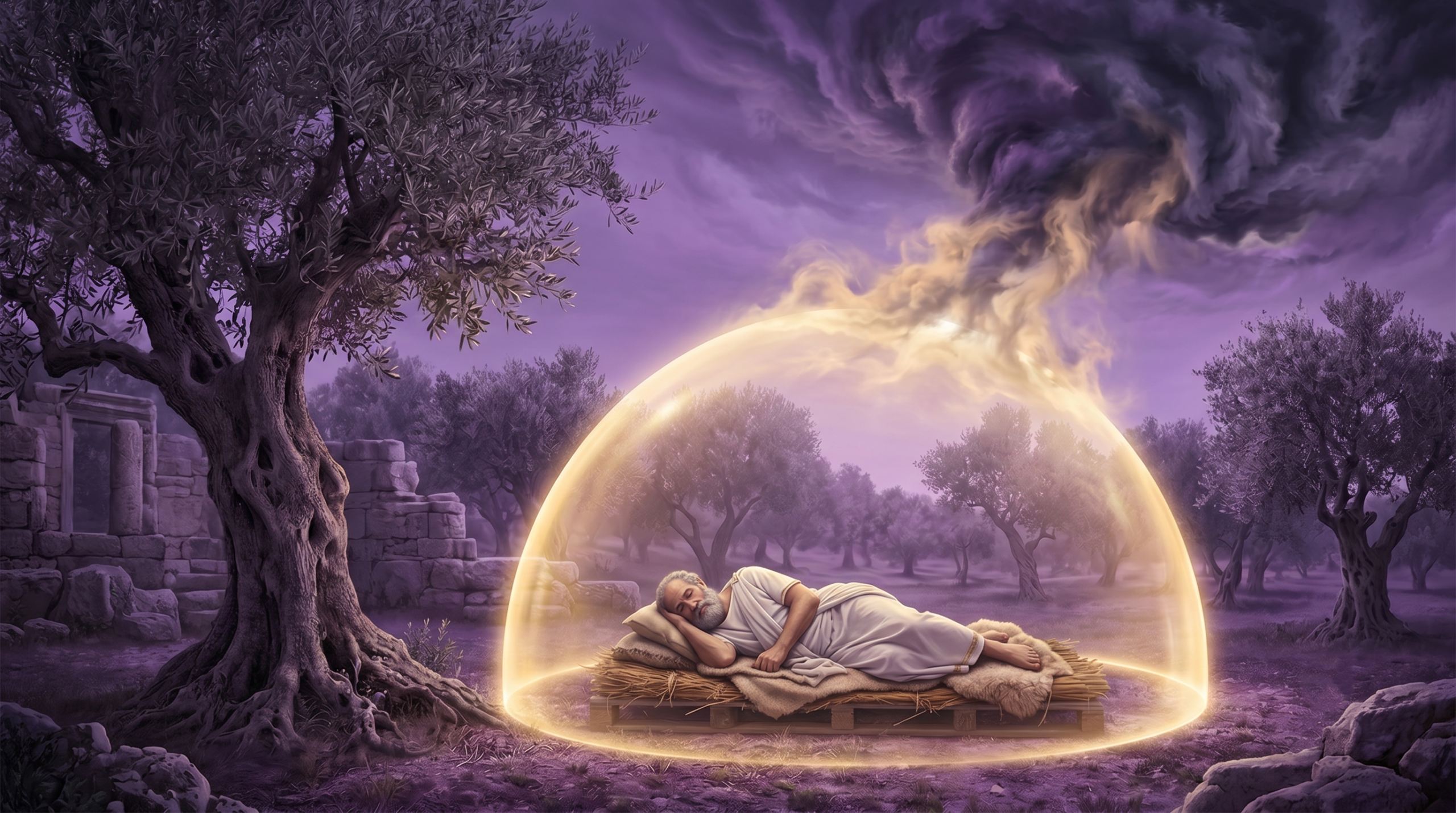
A. Why We Dream During Crises
Imagine being wrongly convicted and sentenced to death. Most of us would assume that our sleep would be plagued by night terrors, cold sweats, and severe insomnia. Why, then, did Socrates experience visions of graceful women in white and beautiful singing swans?
The answer lies in the neurobiology of stress and emotional regulation. During REM sleep, the brain’s logic center (the prefrontal cortex) goes mostly offline, while the emotional and memory centers (the amygdala and hippocampus) become highly active. Furthermore, during this stage of sleep, the brain completely shuts off the release of noradrenaline—a key stress chemical.
This creates a unique, safe biological environment where the brain can process highly emotional or traumatic waking events without the physical sensation of panic. When an individual possesses advanced mindfulness and emotional regulation—as Socrates did through his lifetime of philosophical training—they can actively alter the chemical environment of their waking brain. By accepting his fate with a calm brain during the day, he prevented excessive cortisol from flooding his system, allowing his REM cycle to do its job: soothing him rather than terrifying him.
B. The Subconscious as an Emotional Thermostat
In modern sleep medicine, there is a concept known as “sleep-dependent emotional processing.” Think of the subconscious as an emotional thermostat. When the waking mind becomes too heated by anxiety, fear, or unresolved conflict, the dreaming mind kicks on to cool the system down.
Socrates’ methodical analysis of his dreams is remarkably similar to modern psychological treatments for sleep disorders, specifically Imagery Rehearsal Therapy (IRT) and Cognitive Behavioral Therapy for Insomnia (CBT-I). Both ancient philosophy and modern therapy agree: running away from a disturbing dream only fuels sleep anxiety. Leaning into it, analyzing the symbolism, and rewriting the narrative during your waking hours fundamentally changes how your brain processes stress at night.
Decoding Your Subconscious: 4 Holistic Habits for Modern Sleepers
Understanding the history and science of the subconscious is only the first step. To truly optimize your holistic well-being, you must apply the “Socratic Method” to your own sleep hygiene. Here are four actionable habits to decode your mind and achieve deeper, more restorative rest.
1. Adopt the “Socratic Method” for Your Dream Journal
Most people write down what happened in a dream. To unlock real psychological benefits, you must ask why it happened. Keep a journal by your bedside, but instead of writing a chaotic narrative, use a structured inquiry method.
2. Find Your “Music” to Cure Restlessness
If you suffer from recurring dreams or chronic sleep-onset insomnia, your brain may be sending you a “make music” command. When we suppress our natural inclinations—whether that is a desire to write, paint, change careers, or speak our truth in a relationship—that suppressed energy acts as a neurological stimulant.
Take a personal inventory. What creative or emotional outlet have you been rationalizing away because you are “too busy”? Dedicating just 20 minutes a day to this unresolved passion can act as a powerful, natural sleep aid, signaling to your subconscious that the message has been received.
3. Track the Physical to Understand the Mental
Our dreamscapes do not exist in a vacuum; they are heavily influenced by our physical states, specifically our hormonal fluctuations. Cortisol, melatonin, estrogen, and testosterone all dictate the architecture of our sleep phases, determining how much time we spend in deep sleep versus REM.

To truly map your subconscious, you must correlate your dreams with your biology. Utilizing a Hormone Cycle Sleep Score Tracker is an incredibly powerful way to bridge this gap. By logging your sleep quality alongside where you are in your natural biological cycles, you will begin to notice profound patterns. For instance, you may find your dreams are incredibly vivid and narrative-driven during specific hormonal peaks, while they are fragmented during periods of high cortisol.
(Pro tip for digital wellness: When setting up your own tracking dashboards or viewing your sleep data, use calming visual palettes. Highlighting your key sleep metrics with deep, soothing tones—like a rich amethyst #896499—helps minimize visual overstimulation and keeps the brain relaxed before bed.)
4. Embrace the Unknown (Overcoming Sleep Anxiety)
Socrates’ greatest advantage was his radical acceptance of the unknown. Sleep itself is a vulnerable state; it requires us to surrender control. For many, this loss of control triggers a spike in adrenaline right as they hit the pillow, leading to chronic sleep anxiety.
To combat this, practice “active surrender” during your nighttime routine. Instead of trying to force sleep, focus entirely on muscular relaxation. Acknowledge the thoughts that arise, thank your mind for trying to protect you, and gently visualize stepping into a calm, white space—much like the comforting vision Socrates welcomed in his final days.
Frequently Asked Questions (FAQ)
Did Socrates believe dreams predicted the future?
While he experienced anticipatory dreams (like the arrival of Plato), Socrates generally viewed his dreams as moral imperatives and inner truths rather than literal fortune-telling. He used them as a mirror to examine his own conscience and align his waking actions with his deepest values.
What does a swan symbolize in dreams?
In ancient Greece, swans were sacred to Apollo, the god of music, truth, and healing. In modern dream analysis, dreaming of a swan often symbolizes personal transformation, finding one’s unique voice, grace under pressure, and the realization of untapped waking potential.
How do I stop having stressful recurring dreams?
Recurring dreams are the subconscious mind’s way of forcing you to look at an unresolved issue. To stop them, you must identify the waking conflict the dream represents. Once you take actionable steps during the day to resolve that stressor—just as Socrates finally sat down to write poetry to satisfy his recurring dream—the nighttime loops will naturally break.
Conclusion: Cultivating Your Inner Oracle
The story of Socrates in his final hours is not a tragedy; it is a masterclass in psychological resilience. By asking, what was Socrates dream?, we uncover a timeless truth: the most powerful tool for navigating waking stress is already built into our biology.
Socrates did not rely on external mystics to interpret his visions. He used his own intuition, logic, and self-awareness to decode his subconscious. We all possess this inner oracle. By tracking our physical states, asking the right questions in our dream journals, and finding our own unique “music,” we can transform our sleep from a vulnerable necessity into a profound source of daily wisdom.