
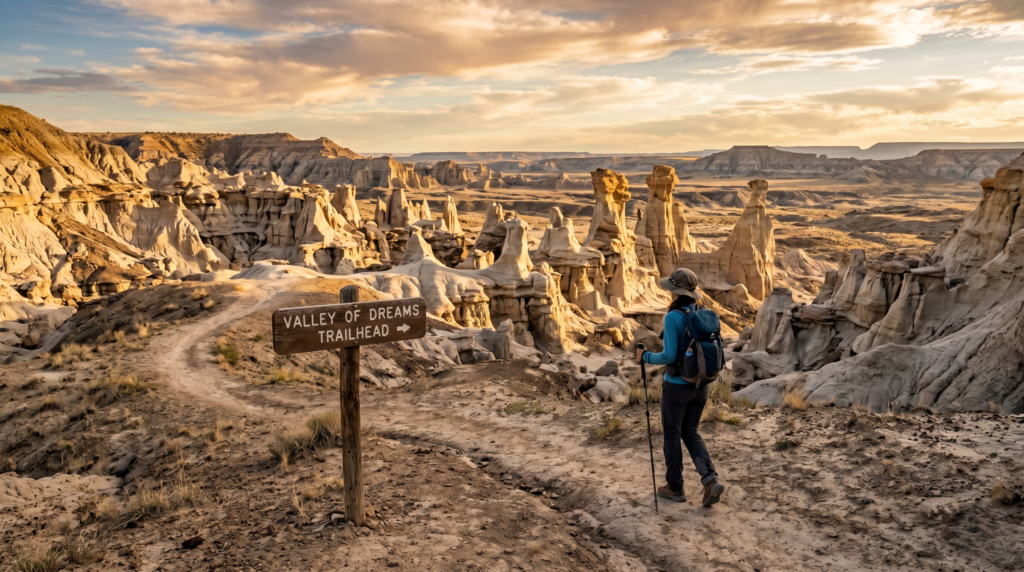
Have you ever stood in a place so entirely detached from the familiar that you wondered if you were still asleep? In the remote expanses of the New Mexico badlands lies a landscape that challenges the boundaries between reality and the subconscious mind. Known for its alien-like hoodoos and ancient petrified wood, finding the valley of dreams trailhead is the first step toward experiencing one of Earth’s most surreal waking dreams.
But locating this hidden desert gem is notoriously difficult. With no paved roads, no grand entrance signs, and no official visitor centers, many seekers get lost before they even begin. This comprehensive guide provides the exact logistical details to safely find your way, while also offering a holistic framework to transform this rugged off-grid hike into a profound walking meditation and grounding experience.
What is the Valley of Dreams? (Geology Meets Psychology)
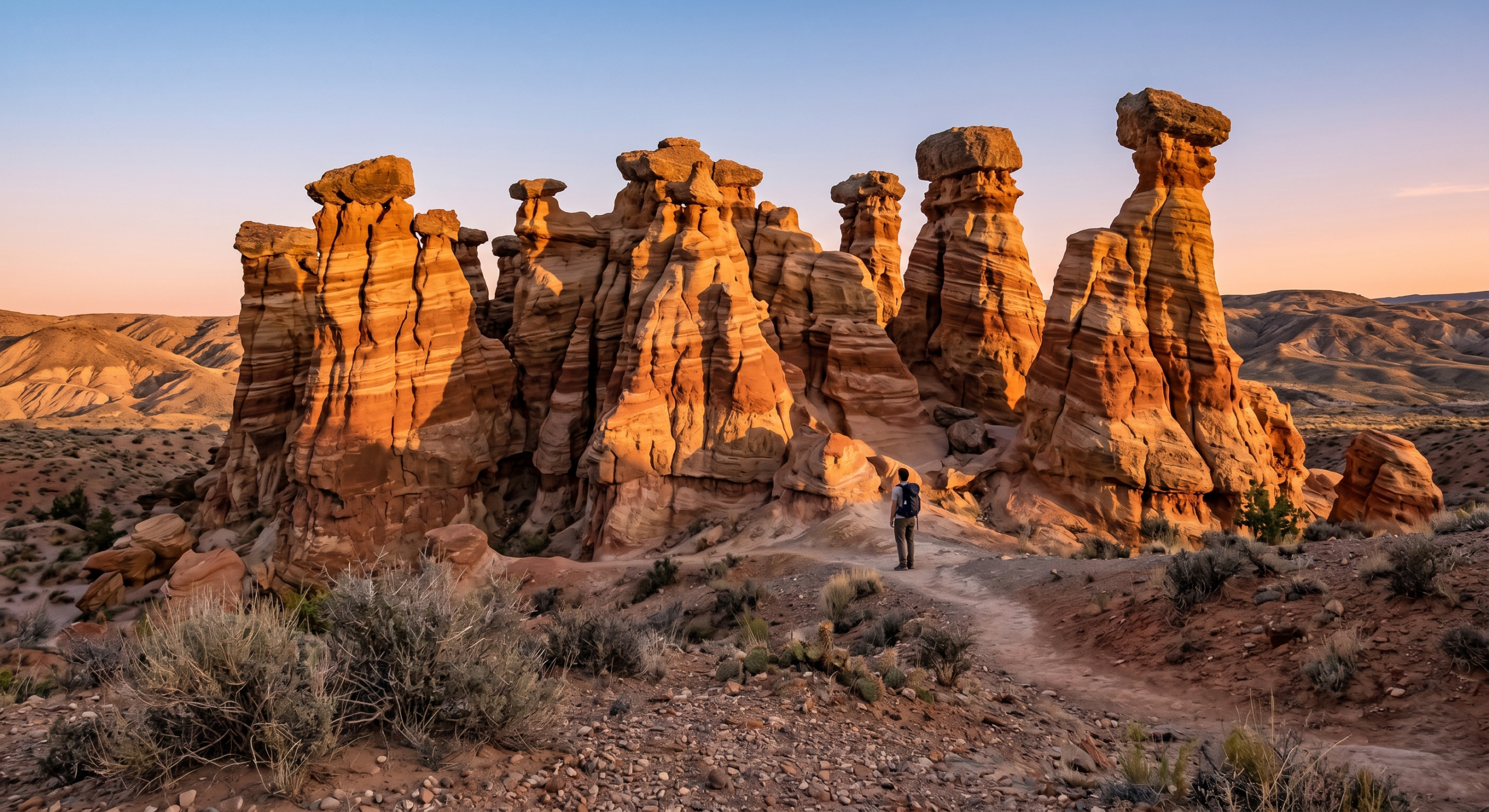
Before you can truly appreciate the journey, you must understand the destination. The Valley of Dreams is an unofficial, remote area within the greater San Juan Basin of northwestern New Mexico, situated near the Ah-Shi-Sle-Pah Wilderness Study Area and the Bisti/De-Na-Zin Wilderness. It is a badland—a dry terrain where softer sedimentary rocks and clay-rich soils have been extensively eroded by wind and water over millions of years. The result is a labyrinth of gravity-defying rock spires, known as hoodoos, alongside massive logs of petrified wood from a prehistoric era.
But beyond the geology lies a powerful psychological trigger. Stepping into the Valley of Dreams induces a profound state of Awe.
The Psychology of Surreal Environments
In the fields of ecotherapy and holistic well-being, awe is defined as the emotional response to perceptually vast stimuli that transcend our current frames of reference. When you walk among the pale, towering hoodoos, your brain struggles to categorize the environment. It feels like a lucid dream.
This “dream state” is highly beneficial for mental health. Psychological studies on nature therapy reveal that experiencing awe actively down-regulates the sympathetic nervous system (our fight-or-flight response). Awe calms the ego, lowers cortisol levels, reduces rumination, and promotes holistic happiness. By embarking on an “awe walk” through the Valley of Dreams, you are not just getting physical exercise; you are participating in a powerful mindfulness practice that can improve your waking clarity and deepen your restorative sleep cycles.
The Navigational Guide: Finding the Valley of Dreams Trailhead
Locating the trailhead is an adventure in itself. Because the Valley of Dreams is located on Bureau of Land Management (BLM) land and remains largely undeveloped, you will not find it easily on standard road maps. It requires preparation, respect for the elements, and precise navigation.
Exact GPS Coordinates and Mapping Your Route
The most critical tool for finding the Valley of Dreams trailhead is a reliable GPS system. Cellular service is virtually nonexistent in this remote pocket of the high desert. You must download offline maps (such as AllTrails, Gaia GPS, or Google Maps offline areas) before leaving your hotel or home base.
-
Trailhead / Parking Area GPS Coordinates: 36.1158° N, 107.9734° W (Note: Coordinates may vary slightly depending on mapping software, but these will get you to the general pull-off area).
To get there, you will typically travel south from Farmington or north from Crownpoint, eventually turning onto County Road 7870, a network of dirt tracks servicing local ranching and energy operations.
Navigating the Dirt Roads: What to Expect
The drive to the trailhead is a lesson in patience and letting go of control—a perfect warm-up for a mindfulness exercise.
-
Vehicle Requirements: Reaching the trailhead requires driving for several miles on unpaved BLM roads. While a standard sedan might make it in perfectly bone-dry conditions if driven with extreme caution, a high-clearance vehicle or a 4WD is strongly recommended.
-
The Weather Warning (Crucial Safety Note): The clay-rich soil of the New Mexico badlands turns into an impassable, slippery substance colloquially known as “gumbo mud” when wet. If it is raining, or has rained heavily in the past 48 hours, do not attempt this drive. Even heavily modified 4×4 vehicles will get stuck. Part of holistic well-being is tuning into the rhythms of nature; if the weather says no, respect the land and wait.
The “Unmarked” Nature of the Trailhead
Do not expect a paved parking lot or a wooden kiosk with trail maps. The Valley of Dreams trailhead is essentially an unmarked dirt pull-off near a barbed-wire fence line. You will know you are in the right general area when you see a rudimentary gate or opening in the fencing, and perhaps the tire tracks of previous adventurers. This lack of structure is a feature, not a bug. It forces you to look up from your screens, observe your environment, and rely on your own intuition and preparation.
Preparing Mind and Body for the Desert
The high desert is an environment of extremes. To engage safely in a waking dream, your physical body must be anchored and cared for.
Physical Essentials for the High Desert
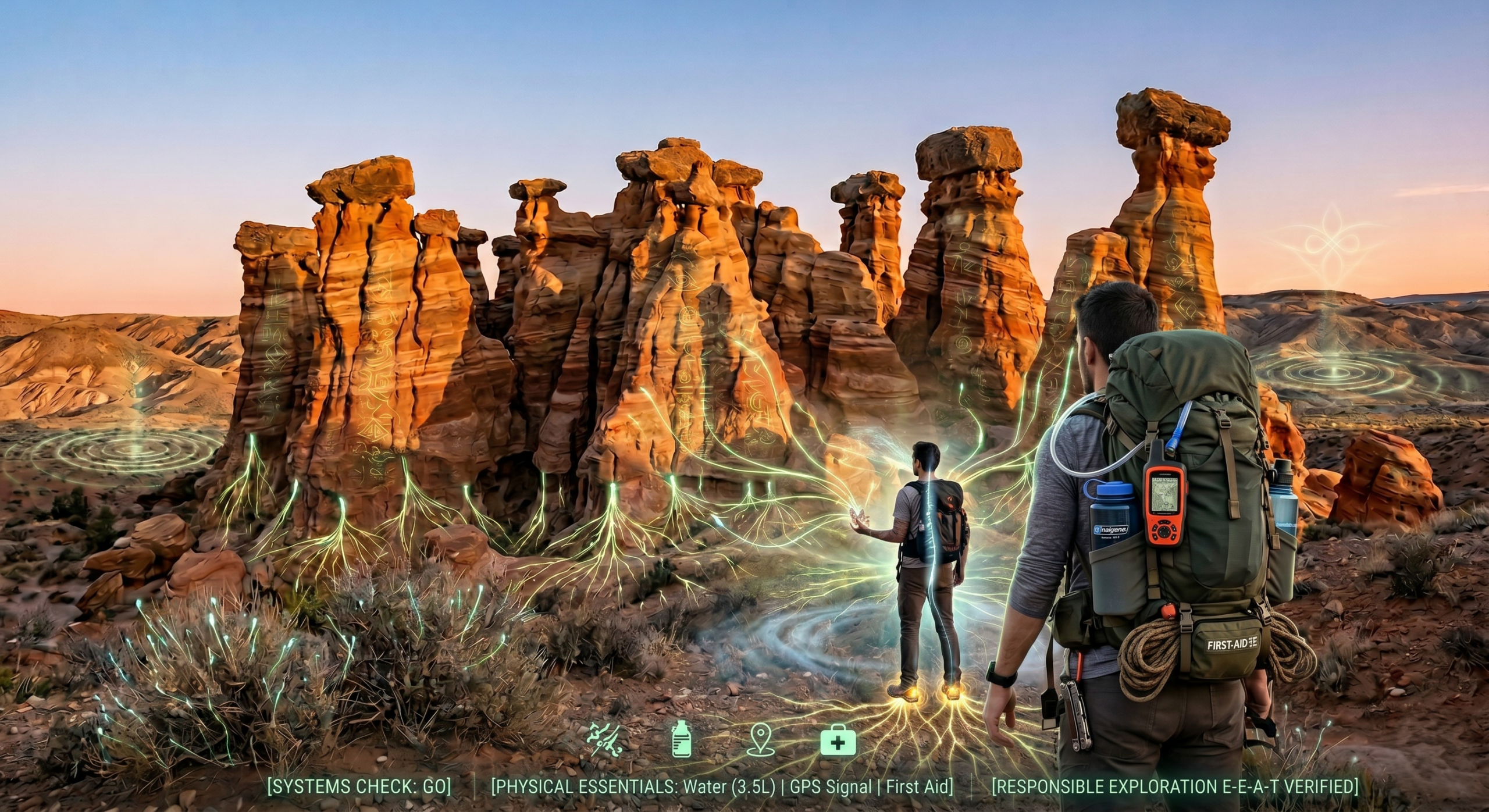
Homeostasis—the body’s ability to maintain a stable internal environment—is essential for clear thinking and mindfulness.
-
Hydration: Bring more water than you think you need. A minimum of one gallon per person per day is the standard desert rule.
-
Sun Protection: There is zero shade in the Valley of Dreams. Wear a wide-brimmed hat, UV-protective clothing, and high-SPF sunscreen.
-
Navigation and Safety: Bring a dedicated GPS device, a compass, and a Personal Locator Beacon (PLB) or satellite messenger (like a Garmin inReach).
-
Footwear: Sturdy, closed-toe hiking boots are necessary to navigate the uneven, rocky, and sometimes soft terrain.
Setting a Spiritual Intention
Once you have parked at the trailhead, resist the urge to immediately rush into the badlands. Take a moment to transition from the stressful, bumpy drive to a state of receptive mindfulness.
A 2-Minute Trailhead Grounding Exercise:
-
Stand facing the vast expanse of the badlands.
-
Close your eyes and take a deep breath in through your nose for a count of four, feeling the dry desert air fill your lungs.
-
Hold for a count of four.
-
Exhale slowly through your mouth for a count of six, visualizing the stress of the journey leaving your body.
-
Repeat this three times. Set an intention for your walk—whether it is to seek inspiration, let go of a specific worry, or simply be fully present in the surreal beauty of the Earth.
A Waking Dream: Walking Meditation Among the Hoodoos
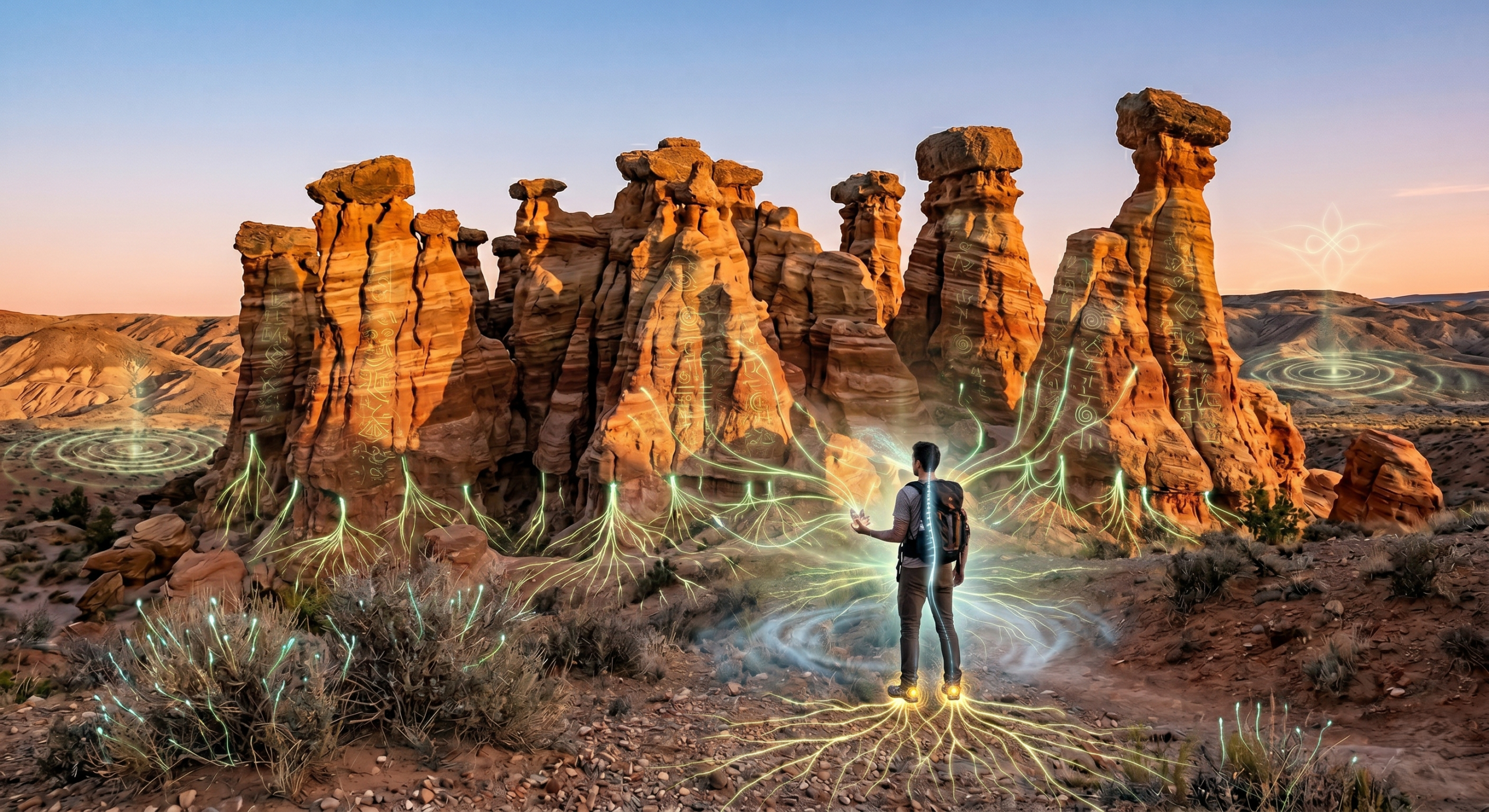
From the trailhead, the journey to the main formations is roughly 1.5 to 2 miles. It is vital to understand that there is no official trail. You are engaging in cross-country navigation.
Navigating the Cross-Country Terrain Mindfully
Walking without a defined path is a powerful metaphor for life. We often seek clear signs telling us exactly where to go, but the Valley of Dreams demands that you chart your own course. Use the landscape to guide you. Drop down into the washes (dry riverbeds) and use them as natural pathways leading toward the pale, alien-looking formations in the distance. Periodically look back the way you came and pick out a distant landmark to ensure you can find your way back to the trailhead.
The “Alien Throne” and Anchors of Awe
As you approach the main cluster of hoodoos, you will encounter formations that defy gravity. The most famous of these is the “Alien Throne,” an intricate, spindly rock formation that looks like a seat carved for an extraterrestrial monarch.
When you find a formation that strikes you, use it as an anchor for a grounding exercise.
The 5-4-3-2-1 Sensory Method in the Badlands:
-
5 things you can see: Notice the distinct layers of colored rock, the shadows stretching across the clay, a piece of petrified wood, the endless blue sky, and a distant mesa.
-
4 things you can feel: The dry heat on your skin, the crunch of the earth beneath your boots, the gentle desert breeze, and the texture of your water bottle.
-
3 things you can hear: The sound of the wind whipping through the hoodoos, your own rhythmic breathing, and the silence of the remote desert.
-
2 things you can smell: The dusty, mineral-rich scent of the dry earth, and perhaps the faint smell of sagebrush in the distance.
-
1 thing you can taste: Take a sip of your water and focus entirely on its cooling, life-giving sensation.
By anchoring your senses, you merge your conscious awareness with the surreal, dream-like environment around you.
Leave No Trace: Honoring the Land and Yourself
Holistic well-being teaches us that we are not separate from our environment; we are deeply intertwined with it. The way we treat the land reflects the way we treat our own inner landscapes.
The Fragility of the Dreamscape
The hoodoos in the Valley of Dreams look like solid stone, but they are incredibly fragile. They are formed from soft mudstone and sandstone capped by a harder piece of rock. Do not touch, lean on, or climb the formations. A single careless touch can destroy a structure that took millions of years to form. Stay on the durable surfaces in the washes and avoid walking on the delicate crust of the soil whenever possible.
Respecting Indigenous Lands
The San Juan Basin is an area of profound historical and spiritual significance. While the Valley of Dreams is on BLM land, it is situated very close to the Navajo Nation. Approach this landscape with the reverence it deserves. Do not remove anything from the area—including rocks, fossils, or pieces of petrified wood. Take only photographs, and leave only footprints.
Frequently Asked Questions (FAQ)
To ensure your journey is as safe and seamless as possible, here are the most common questions regarding the Valley of Dreams trailhead.
Do I need a 4×4 to reach the Valley of Dreams trailhead? While a 4×4 is not strictly required during dry conditions, a high-clearance vehicle is highly recommended to navigate the deeply rutted dirt roads safely. If it has rained recently, the roads become completely impassable, even for heavy-duty 4x4s.
How long is the hike from the trailhead to the formations? The round-trip hike is generally between 3 and 4 miles. However, because there is no set trail and the area begs for exploration, you should plan to spend at least 3 to 4 hours wandering among the hoodoos.
Is it safe to hike the Valley of Dreams alone? Solo desert hiking carries inherent risks due to the lack of cell service, extreme heat, and absence of marked trails. If you choose to go alone, you must carry a satellite communication device, download offline maps, carry excessive water, and tell a trusted contact your exact itinerary and expected return time.
What is the best time of day for a mindful visit? The golden hours—shortly after sunrise or just before sunset—are the best times to visit. Not only are the temperatures safer and more comfortable, but the low angle of the sun casts long, dramatic shadows across the badlands, enhancing the surreal, dream-like quality of the landscape.
Conclusion: Bringing the Dream Back to Reality
Finding the valley of dreams trailhead is an achievement of logistics, preparation, and navigational skill. But exploring the valley itself is an achievement of the spirit.
By venturing into this remote, alien landscape, you are doing more than just checking a hike off a bucket list. You are stepping out of the rigid, concrete structures of modern life and walking straight into a waking dream. It is a place that challenges your perceptions, demands your absolute presence, and rewards you with a profound sense of awe that will linger in your mind long after you have returned to civilization.
Take the stillness of the desert back home with you. Let the silence of the hoodoos inform your meditation practice, and let the surreal beauty of the badlands inspire the landscapes of your own nightly dreams.